The traditional virtual tour is becoming a dinosaur.
The game just changed for pre-construction property sales.
For years, virtual tours have promised to let prospective buyers experience properties without physically visiting them.
And they've certainly come a long way.
But let's be realistic. Most are still collections of panoramic photographs, linked together with hotspots and clever transitions. You can look around, jump to another position and look around again.
Useful? Absolutely.
But is that really the same as walking through a property?
Not quite.
Archiform 3D has developed something fundamentally different. Genuine, photorealistic Spatial 3D, with continuous freedom of movement, running directly in a web browser.
And now we've taken it a step further.
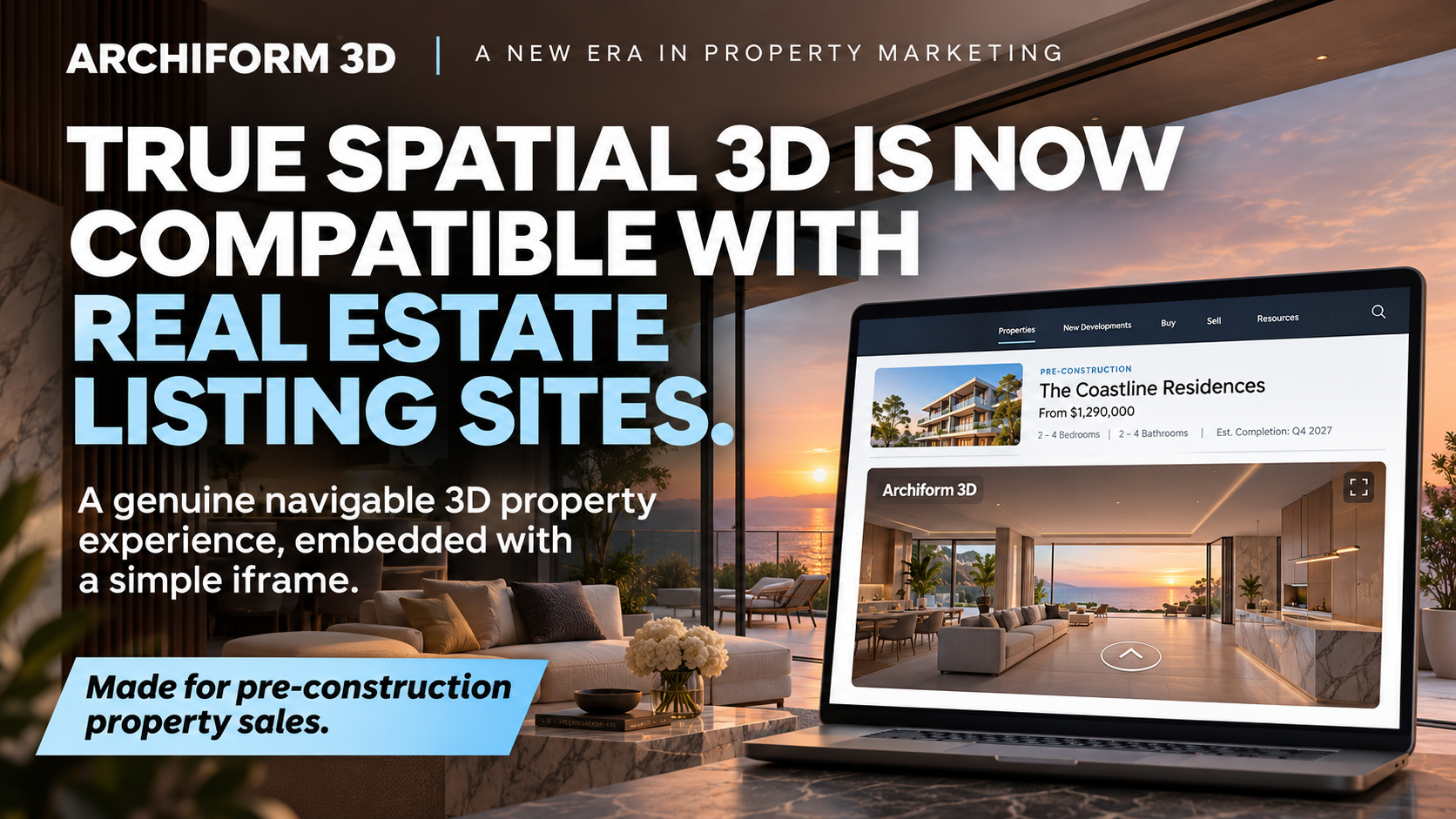
We've refined the technology specifically for integration into real estate websites, allowing complete Spatial 3D experiences to run inside an ordinary iframe.
No specialist software. No complicated installations. No powerful gaming computer required.
Just a property that buyers can actually explore.
How did we get here?
Stephen Bell, founder of Archiform 3D, has spent decades designing luxury residential and resort developments, creating architectural interiors and producing architectural visualisations for projects around the world.
His experience extends well beyond presenting other people's designs. It includes conceiving and developing entire environments, from masterplanning and architecture through to interior design and the finer details of individual residences.
That combination of design experience and visualisation expertise has shaped his approach to emerging technology.
For Bell, the objective has never been simply to make buildings look beautiful. It's to help people understand and experience spaces.
And it's precisely that thinking that led to Spatial 3D.
"I've made 360-degree tours. Boring. Uninspiring. A bit weird-looking, to be frank.
Real-time 3D is where it's at. But we're still a LONG way from having the kind of fully rendered, photorealistic environments I create running efficiently on an ordinary phone.
And let's face it, if it doesn't run on a phone, it's a waste of time.
So I started looking at the problem differently. I devised a Spatial 3D approach, and the whole game changed."
So what exactly is Spatial 3D?
The difference is easier to experience than to explain.
Traditional virtual tours generally rely on predetermined viewpoints. You stand at one position, look around, then select another position and transition to it.
Spatial 3D removes that restriction.
Instead of moving between fixed viewpoints, you move continuously through a photorealistic three-dimensional environment.
Walk across a living room. Approach the kitchen. Move towards the balcony. Turn around and look back across the space.
Your perspective changes naturally as you move, just as it would in the physical world.
There are no predetermined camera positions dictating where you must stand.
And because the environment has genuine spatial depth, the relationships between spaces become far easier to understand.
It's the difference between looking at pictures of a property and beginning to experience the property itself.
Behind the scenes, Archiform 3D uses advanced Gaussian splatting techniques, sophisticated 3D production methods and purpose-built browser technology to deliver these environments with remarkable visual fidelity.
The technical achievement is substantial.
But for the person exploring a property, none of that should matter.
They should simply be able to walk in and look around.
You might be thinking of Matterport
And that's perfectly understandable.
Matterport is a very capable product. It's helped establish interactive property experiences as an important part of real estate marketing, and it's done an excellent job of bringing existing spaces to life online.
There is, however, an interesting distinction in how the familiar Matterport walkthrough and Archiform 3D's Spatial 3D work.
Matterport's conventional walkthrough experience is based on captured viewpoints, with sophisticated transitions helping visitors move between them. Its technology also incorporates genuine three-dimensional information about the spaces it captures.
Spatial 3D takes a different approach.
Instead of moving between predetermined viewpoints, visitors can move continuously through the environment, changing their position and perspective naturally.
It might sound like a subtle distinction.
In practice, it changes the experience considerably.
And there's another particularly important difference for property developers.
Matterport's principal strength is capturing and presenting environments that already exist.
Archiform 3D can create Spatial 3D environments directly from architectural designs, long before construction begins.
The residence might still be on the drawing board.
The tower might not have risen above ground level.
The entire development might exist only as architectural plans and digital models.
Yet prospective buyers can already begin exploring it.
For pre-construction property sales, that's a rather significant development.
The breakthrough isn't just the 3D. It's getting it onto a phone.
Producing beautiful real-time architectural environments on powerful workstations isn't new.
Making visually convincing, freely navigable environments practical on ordinary consumer devices is a very different challenge.
As Bell explains:
"I can create incredible real-time environments on my workstation. That's not the problem.
The problem is getting that quality into the hands of somebody browsing properties on their phone.
I don't want buyers worrying about graphics cards, software or how the technology works. I want them to open a property listing and explore.
That's when this technology becomes genuinely useful."
Spatial 3D combines photorealistic spatial rendering with adaptive streaming and device-aware performance optimisation.
Different devices have different capabilities, so the experience can adjust the amount of visual data being delivered and displayed.
A powerful desktop computer can take advantage of greater detail, while mobile devices can be served a more appropriate version of the same environment.
The objective is straightforward: make sophisticated spatial experiences accessible to ordinary property buyers, wherever they happen to be.
And that led to the next question.
If Spatial 3D can run directly in a browser, why should it be confined to a dedicated demonstration website?
And now, the really interesting part. It's just an iframe.
An iframe is one of the simplest and most established technologies on the web.
It's how websites can display externally hosted content within their own pages.
You've probably encountered thousands of them without giving the technology a second thought.
Archiform 3D has now refined Spatial 3D specifically for this kind of embedded presentation.
An entire photorealistic, freely navigable spatial environment can run inside an ordinary webpage using a standard HTML iframe.
Think about that for a moment.
The same basic mechanism used to embed a map or video can now contain an interactive three-dimensional architectural environment.
A prospective buyer can arrive at a property webpage, open the Spatial 3D experience and begin exploring.
The experience can operate within the available space on the page or expand into fullscreen for a more immersive view.
No separate application to download.
No specialised 3D viewer to install.
No remotely streamed gaming workstation required.
Just the familiar web, doing something rather extraordinary.
See it for yourself
Experience one of our live Spatial 3D environments below. Move through the space, change your viewpoint and explore it naturally.
A new opportunity for real estate agents
For real estate agents, the implications are particularly interesting.
Property listings have traditionally been built around photographs, descriptive text, floor plans and, increasingly, video or virtual tours.
All remain valuable.
Spatial 3D adds another dimension to that presentation — quite literally.
Instead of asking buyers to imagine the relationship between rooms, agents can offer an experience in which buyers explore those relationships themselves.
A residence can be experienced from multiple positions, rather than from a limited selection of carefully composed images.
A prospective purchaser can investigate the flow between living areas, study the kitchen, approach windows and balconies, and develop a much clearer understanding of how a property is arranged.
And because Spatial 3D operates in a browser, the experience can be incorporated into an agent's own website or compatible real estate listing platforms that support externally hosted interactive content.
Different listing platforms have their own technical requirements and publishing policies, so embedding is subject to each platform's approval and capabilities. Where direct embedding isn't permitted, a conventional link can provide access to the hosted experience.
The result is a flexible presentation format that can work across multiple marketing channels.
One spatial environment. Multiple opportunities to put it in front of buyers.
But it's pre-construction sales where things get really interesting
For existing homes, interactive property experiences are already well established.
For properties that haven't been built, the opportunity is considerably more compelling.
Consider an apartment development in its early marketing stages.
Traditionally, prospective buyers are asked to make substantial purchasing decisions using floor plans, architectural renderings, brochures and perhaps a cinematic walkthrough.
These can be beautifully produced, but they still require the buyer to interpret what they're seeing.
How spacious will the living area feel?
What happens when you move from the kitchen towards the balcony?
How does the master bedroom connect to the other spaces?
What will the outlook be like from different parts of the residence?
Spatial 3D allows buyers to explore those questions themselves.
Using architectural designs, Archiform 3D can develop the proposed property as a complete visual environment, incorporating the intended architecture, interiors, materials and surrounding context.
The buyer can move through the design, develop an understanding of its proportions and experience how spaces connect.
And all of this can happen before the first concrete slab is poured.
For developers and their sales teams, that represents a fundamentally different approach to presenting off-the-plan property.
It's no longer just about showing buyers what the development might look like.
It's about letting them experience what they're buying.
The technology should be invisible
Perhaps the most satisfying part of this development is how little the buyer needs to know about it.
They don't need to understand Gaussian splatting.
They don't need to know anything about real-time graphics, spatial reconstruction or streaming optimisation.
They don't even need to understand what an iframe is.
They simply encounter a property, enter it and begin exploring.
That's the real objective.
Not more complicated technology for its own sake, but sophisticated technology that makes something fundamentally easier.
Traditional virtual tours helped establish the idea that property could be explored online.
Spatial 3D takes that idea in an entirely new direction.
And by making it practical on ordinary devices and compatible with straightforward web integration, Archiform 3D is bringing that capability closer to where it matters most.
The property websites and listings buyers already use.
The age of Spatial 3D has begun.
And for pre-construction property sales, the game just changed.
Explore Spatial 3D by Archiform 3D
Experience real, navigable spatial environments, including residential interiors and complete developments, and discover how Spatial 3D can become part of your property marketing.